

Governance that ships: AI guardrails that speed you up, not slow you down
Bottom line: Most AI governance is designed as a gate — a review board whose default answer is "not yet" — and a gate has exactly two outcomes: teams wait and ship nothing, or they route around it and ship ungoverned. Neither is governance. The alternative is to design governance as a paved road, where the safe, compliant path is also the fastest and easiest one. Done that way, guardrails stop being the thing that slows AI down and become the thing that lets it move quickly without doing harm.
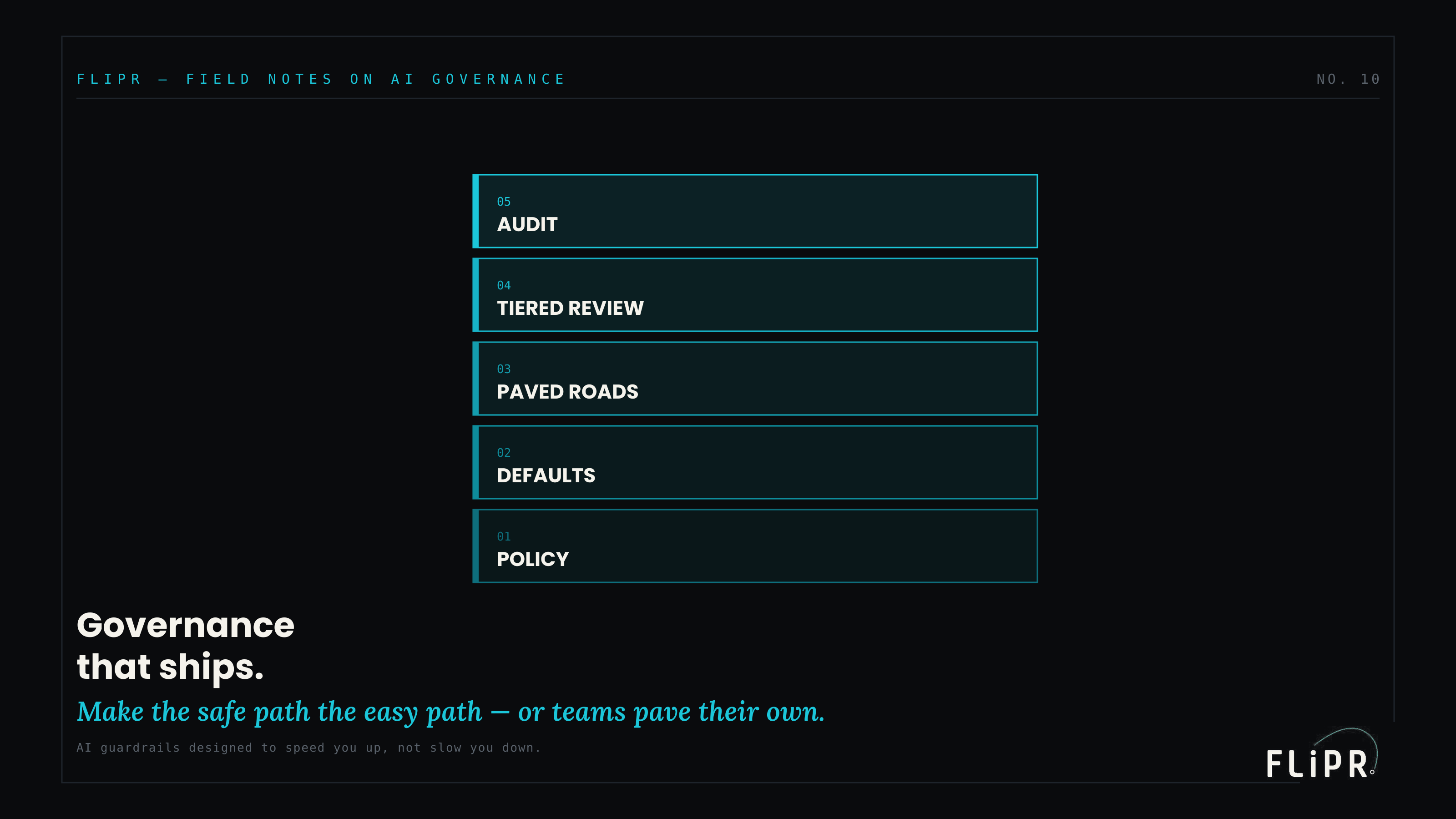
Your governance board is creating shadow AI
The well-intentioned response to AI risk is to stand up a governance board: a committee that reviews and approves AI use cases before they ship. The logic is sound — AI carries real risk, so someone should check it before it reaches customers. But a central approval board has a predictable failure mode that undermines the entire purpose. Review becomes a bottleneck, the queue grows, and teams under delivery pressure face a choice between waiting weeks for approval or quietly building without it. Many choose the latter. The result is shadow AI: systems built and shipped outside the governance process entirely, which is the precise opposite of what the board was created to prevent.
This is the central paradox of gate-based governance: the harder the gate, the less it actually governs. A board that says no, or says yes slowly, does not stop risky AI from being built — it stops risky AI from being built visibly. The work moves into the shadows, where there is no policy, no review, and no audit trail, governed by nothing but the judgment of whoever was in a hurry. A governance function that teams route around is not a safeguard. It is a blind spot wearing the costume of one.
A gate teams route around does not reduce risk. It relocates risk to where you cannot see it — and calls that governance.
Governance is a road, not a gate
The error is treating governance as a question of permission — should this be allowed — when it should be a question of design — how do we make the safe thing the easy thing. A gate sits in the path and asks the traveler to stop and request passage. A road is built so that following it is simply the most natural way to get where you are going. The difference is not strictness; a road can enforce plenty of constraints. The difference is that a road works with the traveler's incentive to move quickly, while a gate works against it — and incentives win.
Think about how good security infrastructure already works in mature engineering organizations. Developers do not file a request to use encryption; encryption is the default in the libraries they already reach for. They do not seek approval to handle secrets safely; the platform makes the safe way the path of least resistance. The constraint is real and enforced, but it is built into the road rather than standing as a gate across it, so the safe path is also the fast path and nobody is tempted to leave it. AI governance can work the same way — and when it does, compliance stops being a tax on speed and becomes a consequence of it.
The Guardrail Stack
Governance-as-a-road has five layers, each doing more of the work automatically than the one above it.
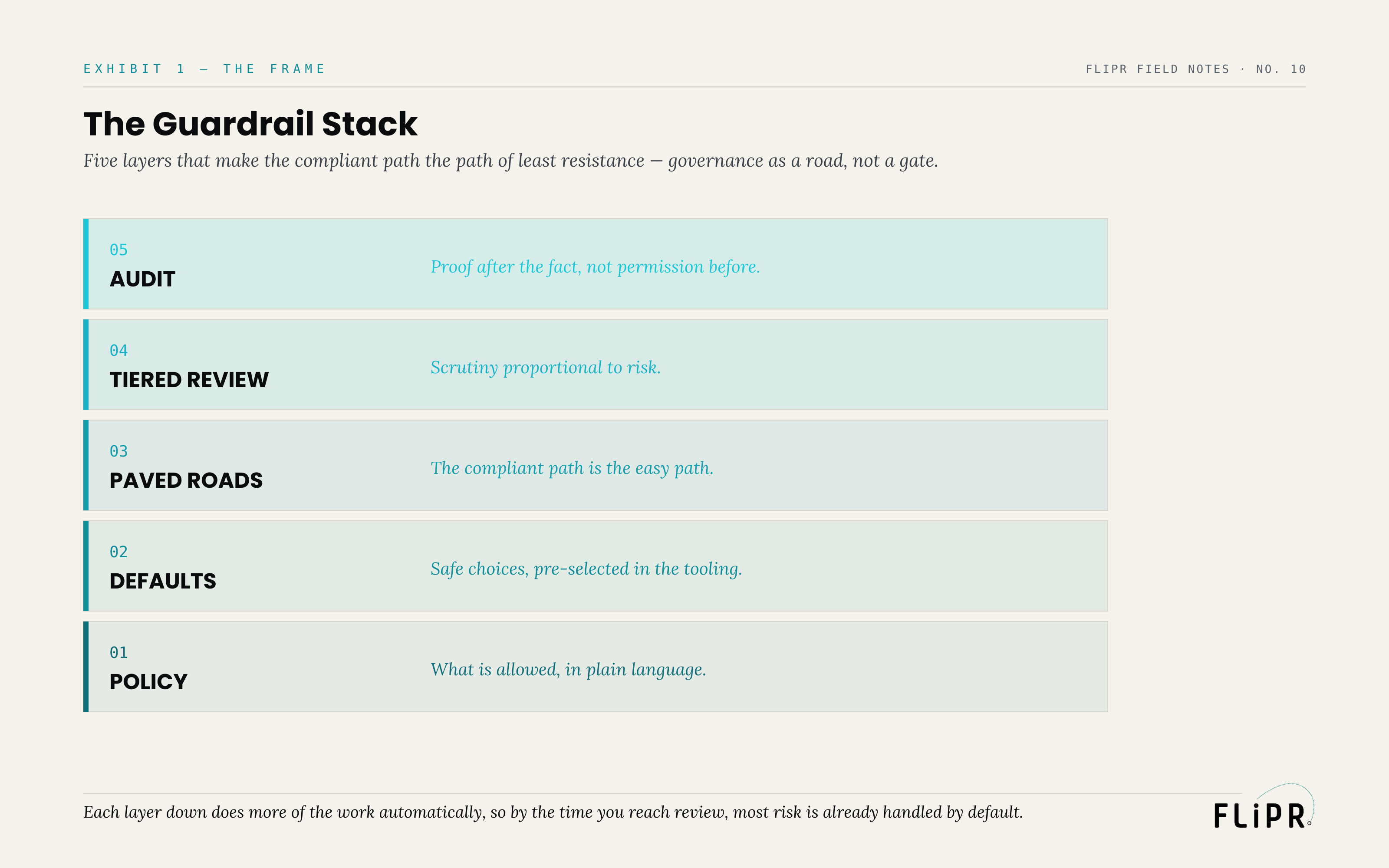 Exhibit 1. Five layers that make the compliant path the path of least resistance — governance as a road, not a gate.
At the top is policy: a clear statement, in plain language, of what is allowed and what is not. Below it, defaults: tooling where the safe choices are pre-selected, so doing nothing special produces a compliant result. Below that, paved roads: the sanctioned, supported path that is genuinely the easiest way to build, so teams choose it because it is fastest, not because they are forced. Below that, tiered review: human scrutiny applied in proportion to risk, concentrated where it matters rather than spread evenly across everything. And at the base, audit: the ability to prove after the fact what was built and how, so that trust does not depend on inspecting everything before it ships. The deeper you go in the stack, the more risk is handled automatically — so by the time a project reaches human review, the defaults and paved roads have already disposed of most of the risk, and review can focus narrowly on what is genuinely novel or dangerous.
The shift this enables is from "approval before you build" to "guardrails that make the right thing the default thing." Most of the governance happens without anyone filing a request, because it is built into the tooling and the path. That is what lets governance scale without becoming the bottleneck.
The goal is not a board that reviews everything. It is a road where most of the safe choices have already been made for you by the time you start.
Tiering review to risk
The layer that most often breaks gate-based governance is review, because a board that reviews everything reviews nothing well. The fix is to tier scrutiny to risk.
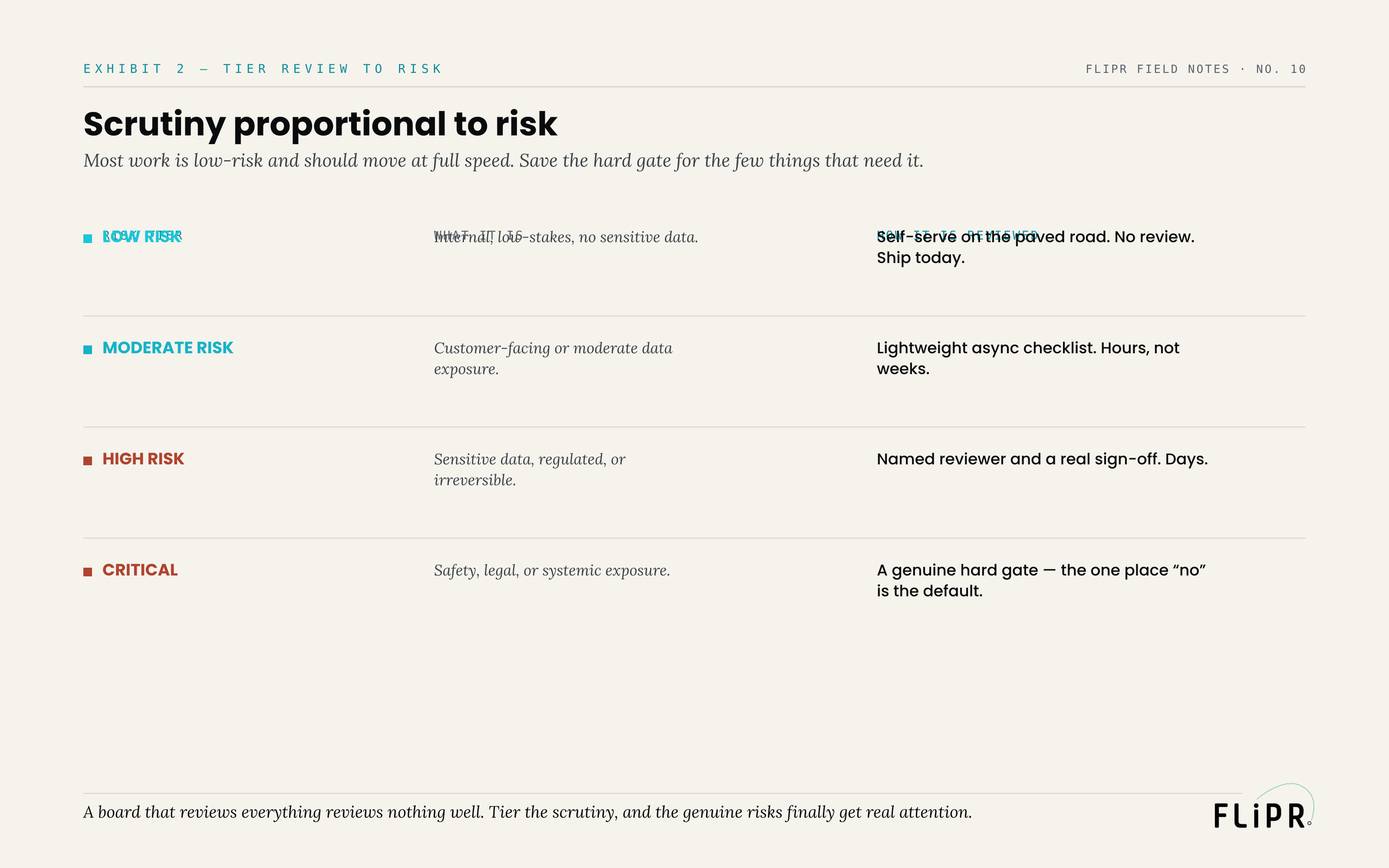 Exhibit 2. Most work is low-risk and should move at full speed. Save the hard gate for the few things that need it.
Low-risk work — internal, low-stakes, no sensitive data — should move on the paved road with no review at all, shipping the same day. Moderate-risk work, such as customer-facing features or moderate data exposure, warrants a lightweight asynchronous checklist that takes hours, not weeks. High-risk work — sensitive data, regulated domains, irreversible decisions — earns a named reviewer and a real sign-off, measured in days. And critical work, where safety, legal, or systemic exposure is on the line, gets a genuine hard gate, the one place where "no" is the appropriate default. The point is that most work is low-risk and should not wait behind the small fraction that is genuinely dangerous. When every use case goes through the same heavy review, the trivial cases clog the queue and the dangerous ones get the same rushed attention as everything else. Tier the scrutiny, and the genuinely risky work finally gets the careful attention it deserves — because it is no longer drowning in a backlog of low-stakes requests.
What this looks like on Monday
Set two governance models side by side, facing the same risks. (This is an illustration, not an account of any specific engagement.)
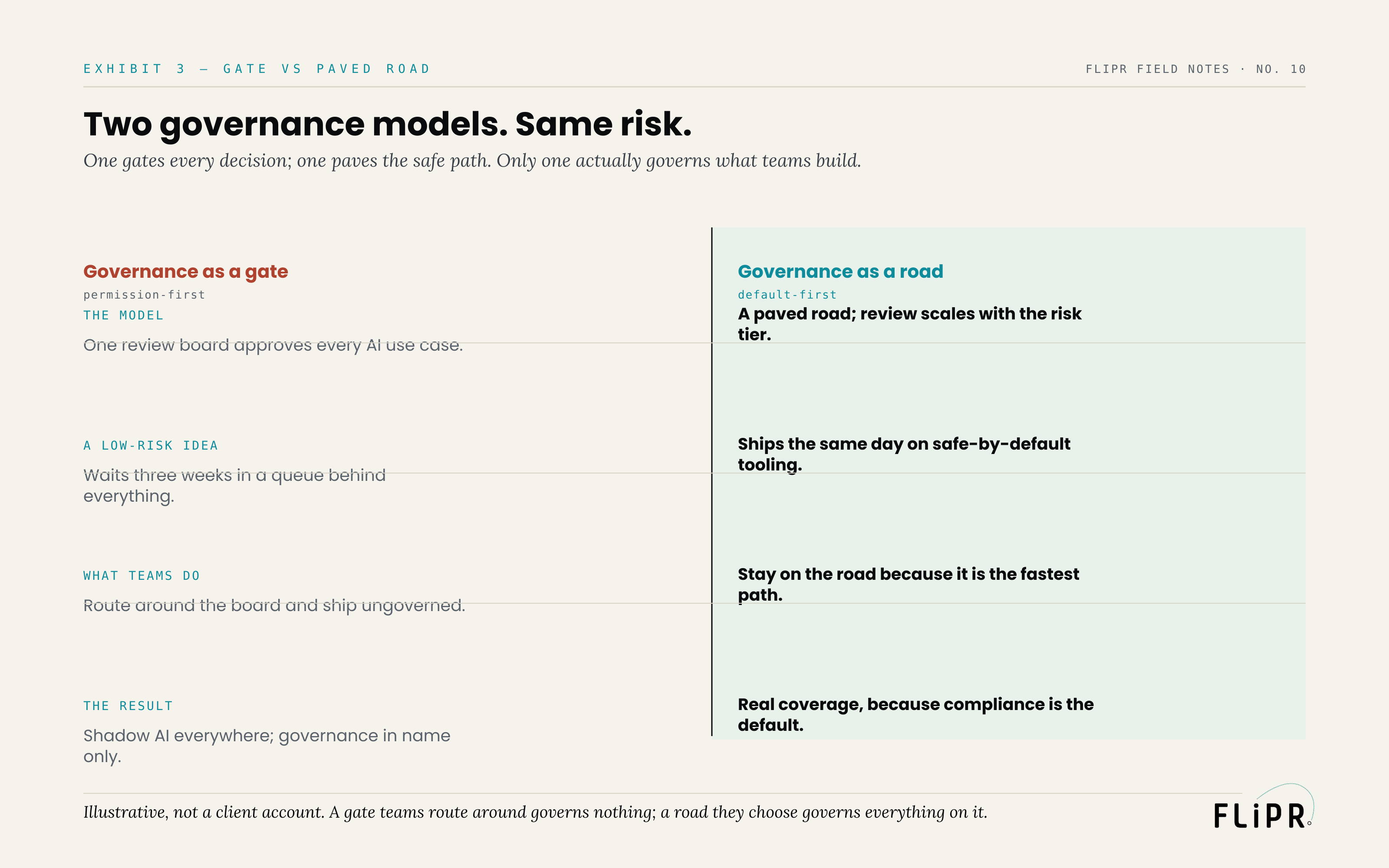 Exhibit 3. One gates every decision; one paves the safe path. Illustrative, not a client account.
The first governs with a gate. One review board approves every AI use case, regardless of risk. A low-risk internal idea waits three weeks in a queue behind everything else. Under pressure, teams start routing around the board and shipping ungoverned. The result is shadow AI everywhere and governance that exists in name only — a policy document and a committee, with the actual building happening somewhere the committee cannot see.
The second governs with a road. There is a policy, but it is enforced through safe-by-default tooling and a paved path, with review scaled to the risk tier. The same low-risk idea ships the same day on the sanctioned tooling. Teams stay on the road not because they are forced but because it is the fastest way to build. The result is real coverage, because compliance is the default state rather than an obstacle — the safe path is the one teams actually take.
Same risks, same organization. One model gated every decision and governed almost nothing; the other paved the safe path and governed everything on it.
Where this argument fails, and what it costs
The road model has limits worth being honest about.
Some decisions genuinely need a hard gate, and the paved-road philosophy must not erode that. Where the stakes are existential — safety-critical systems, irreversible legal exposure, use cases that could harm people at scale — a real stop-and-approve gate is correct, and the tiered model preserves exactly that for the critical tier. The road is for the many low-risk cases, not a reason to remove the gate from the few that need it. There is also a risk that defaults entrench bad choices: a safe-by-default setting is only as good as the judgment behind it, and a default that is wrong becomes a systemic error propagated everywhere at once, so defaults need ownership and revision, not set-and-forget. And audit can become theater — a trail nobody reviews, providing the comfort of governance without the substance — so the audit layer is only real if someone actually looks. The discipline is to pave the road for the common case while keeping a genuine gate for the critical one, and to treat defaults and audit as living responsibilities rather than artifacts.
That bounds the claim. Keep the hard gate where stakes are existential, own and revise your defaults, and make audit real by actually reviewing it. The point is not the absence of control; it is control that works with the grain of how teams build instead of against it.
The decision
Here is the move this points to before your next AI governance review, and it is concrete.
Stop measuring your governance by how much it reviews and start measuring it by how little gets built outside it. Audit your current process for the tell of gate-based failure — is there shadow AI, are teams routing around the board — and if there is, the problem is the gate, not the teams. Then build the stack: write policy in plain language, make your tooling safe by default, pave a sanctioned path that is genuinely the easiest way to build, tier review so scrutiny matches risk, and make audit real. Reserve the hard gate for the critical tier alone, and let everything else move at the speed of the road.
AI will move at the speed your governance allows, and if your governance is a gate, your teams will either wait or pave their own road around it. Build the road yourself, make the safe path the easy path, and concentrate your hard "no" on the few cases that truly warrant it. That is how governance stops being the brake and starts being the thing that lets you move fast without breaking what matters — the same proportional-to-stakes logic that decides what to automate in the companion piece on the automation line, applied to how you govern rather than what you build.
Sources
- Deloitte — State of Generative AI in the Enterprise (2024–2025). Governance, risk, and regulatory concern among the leading barriers enterprises report to scaling AI. https://www2.deloitte.com/
- McKinsey — The State of AI (annual survey). Risk management and governance practices associated with capturing value from AI safely. https://www.mckinsey.com/capabilities/quantumblack/our-insights/the-state-of-ai
Bottom-line summary (one line)
Gate-based AI governance creates shadow AI by making the safe path the slow path — so build a Guardrail Stack (policy, defaults, paved roads, tiered review, audit) that makes compliance the default and reserve the hard gate for the few genuinely critical cases.
Suggested LinkedIn hooks (link back to the blog)
- Your AI governance board may be creating the exact thing it was built to prevent: shadow AI. A gate teams route around doesn't reduce risk — it hides it. [link]
- Good governance is a road, not a gate. Developers don't request permission to use encryption — it's the default. AI guardrails can work the same way. [link]
- A board that reviews everything reviews nothing well. Tier scrutiny to risk: ship low-risk work the same day, and save the real gate for the few cases that need it. [link]